Allow All Sites To Use Key Generation In Forms Chrome
- Allow All Sites To Use Key Generation In Forms Chrome 2017
- Allow All Sites To Use Key Generation In Forms Chrome Download
- Allow All Sites To Use Key Generation In Forms Google Chrome
Allow All Sites To Use Key Generation In Forms Chrome 2017
To use the Google Awareness API, you must add a Google API key to your app. Thetype of API key you need is an Android API key.
Sep 23, 2015 I’ve upgraded to Windows 10 and now can’t use Edge. Issues if try to log on to just about any website – such as bank, credit card, utility, etc. Edge will “hang” on use ID or password. Only thing that has worked is to cut and paste into field. If go to Chrome can get right in sites. Issues on form fill or selection on websites.
Allow All Sites To Use Key Generation In Forms Chrome Download
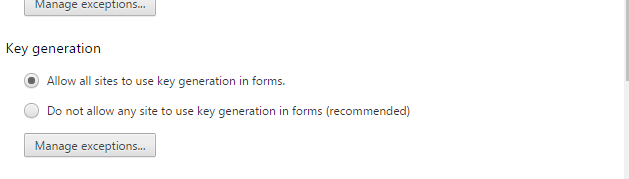
- Use key generation - Done Restart Google Chrome. Note: For versions Chrome 50 and onwards, please open Google chrome and follow the below steps: Click on the lock icon on the left side of the URL - Site settings - Key generation - Add an exception for myapnic.net. Log onto MyAPNIC and go to My Profile - Digital Certificate. Click on “Get a certificate”.
- How to enable Trusted sites in Chrome and what are the benefits? Adding trusted sites to your browser is a very useful utility option that many people overlook and in our opinion this is because they are not even aware of what it does.
- PolicyPak for Google Chrome. We give you the ability to make your users happy but enable you to retain control of critical Chrome browser settings at the same time. With PolicyPak you’ll be able to perform these enterprise “must haves” with Google Chrome.
- Help Chrome keeps signing me out of all websites (even if I click “keep me logged in” on the website itself I tried all sollutions I could find but the are mostly pretty old or not working at all.
- The reason Google defaults this option to 'Do not allow any sites to use key generation in forms' is likely because of two things: From what I can gather, allowing the website to generate its own key is becoming deprecated, and because it is less secure.
- I recently went to settings in Google Chrome in Settings - Advanced - Content settings and under 'Key generation' it had an option 'Do not allow any site to use key generation in forms (recommended)' I can't wrap my head around why it is recommended not to use key generation.
All Android apps are signed with a digital certificate for which you hold theprivate key. For more information about digital certificates, refer to theAndroid guide on how tosign your app.
Android API keys are linked to specific certificate-package pairs. You onlyneed one key for each certificate, no matter how many users you have for theapp.
Several steps are required for you to get a key for your app. They're describedin detail in this guide, and are summarized as follows:
- Get information about your app's certificate.
- Register a project in the Google Developers console and add the User ContextAPI as a service for the project.
- Request a key.
- Add the key to your app. To do so, add an element to your app manifest.
Find your app's certificate information
The API key is based on a short form of your app's digital certificate, known as its SHA-1 fingerprint. To display the SHA-1 fingerprint for your certificate, first ensure that you use the right certificate. You might have the following two certificates to choose from:
- A debug certificate: The Android SDK tools generate this certificate automatically when you do a debug build. Only use this certificate with apps that you're testing. Don't attempt to publish an app that's signed with a debug certificate. The debug certificate is described in more detail in the Sign your debug build section in the Android developer documentation.
- A release certificate: The Android SDK tools generate this certificate when you do a release build. You can also generate this certificate with the
keytoolprogram. Use this certificate when you're ready to release your app to the world.
For more information about keytool, see its Oracle documentation.
Display the debug certificate fingerprint
Use the keytool program with the -v parameter to display a certificate's SHA-1 fingerprint. To do so, complete the following steps:
Locate your debug keystore file. The file name is
debug.keystore, and it's created the first time you build your project. By default, it's stored in the same directory as your Android Virtual Device (AVD) files:- OS X and Linux:
~/.android/ - Windows Vista and Windows 7:
C:Usersyour_user_name.android
- OS X and Linux:
List the SHA-1 fingerprint:
For Linux or OS X, open a terminal window and enter the following:
For Windows Vista and Windows 7, run the following:
Allow All Sites To Use Key Generation In Forms Google Chrome
You should see output similar to the following:
